
The FIFA World Cup is once again at the center of global attention. Every four years, the tournament captures the interest of millions of fans around the world. But while the action unfolds on the pitch, another battle takes place behind the screen.
On one side are the rights holders, broadcasters, and streaming platforms that invest heavily in acquiring broadcasting rights, producing content, and delivering it to audiences. On the other are piracy networks looking to profit from that same demand through unauthorized distribution.
The commercial value of the FIFA World Cup has grown far beyond the tournament itself. Broadcasting rights are no longer just an additional source of revenue for sports organizations, they have become one of the foundations of their business model. The World Intellectual Property Organization has repeatedly highlighted that broadcasting and media rights play a critical role in the financial sustainability of sports organizations and competitions. In many cases, they generate more revenue than ticket sales, merchandise, or sponsorships.
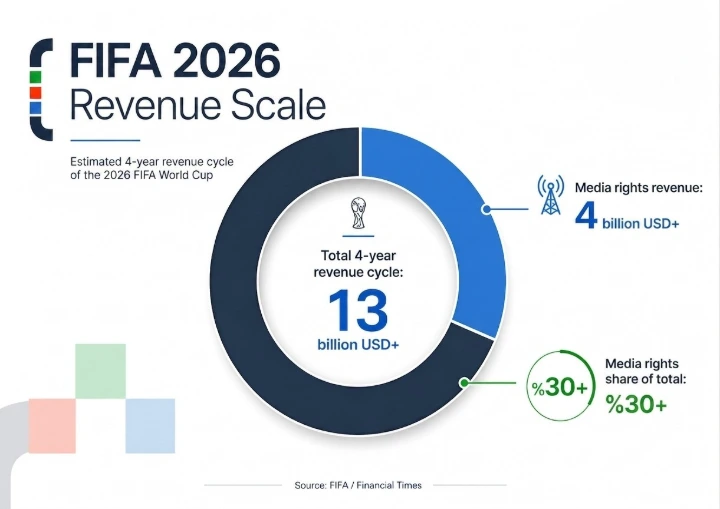
This is also where live sports fundamentally differ from films, TV series, or other forms of digital content: timing.
A film or a series can continue generating revenue long after its release. Audiences can return to it days, weeks, or even months later. Live sports work differently. Their commercial value is concentrated within a very narrow window. Interest peaks while the event is taking place. Once the final whistle blows and the result is known, much of that value disappears.
This is not a new observation. Years ago, the OECD pointed to a challenge that remains just as relevant today: when it comes to live events, being legally right does not necessarily prevent commercial losses if enforcement comes too late. The economic value exists while the event is live. Once that moment has passed, much of the damage has already been done.
The European Commission echoed the same concern in its 2023 Recommendation on combating online piracy of live events. It emphasizes that the commercial value of a live broadcast declines rapidly once the event ends, making timely enforcement essential for rights holders and broadcasters alike.
That is why speed matters.
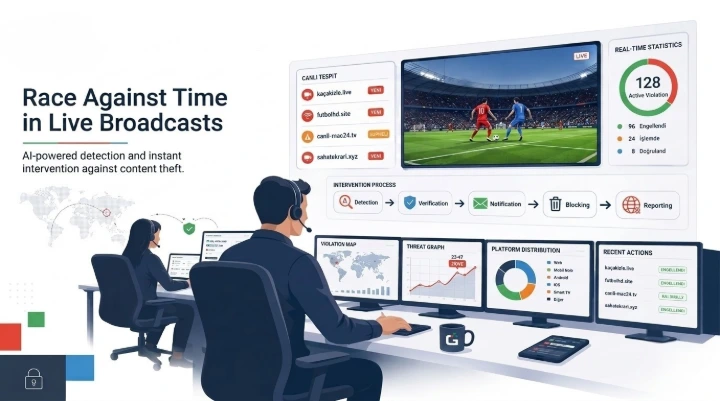
The earlier unauthorized streams are detected and addressed, the greater the chance of limiting commercial losses. If enforcement starts too late, the correct legal action may still be taken but the most valuable part of the broadcast has already passed.
The start of the FIFA World Cup also marks one of the busiest periods for piracy networks. As audience demand reaches its peak, so does the volume of unauthorized streaming activity.
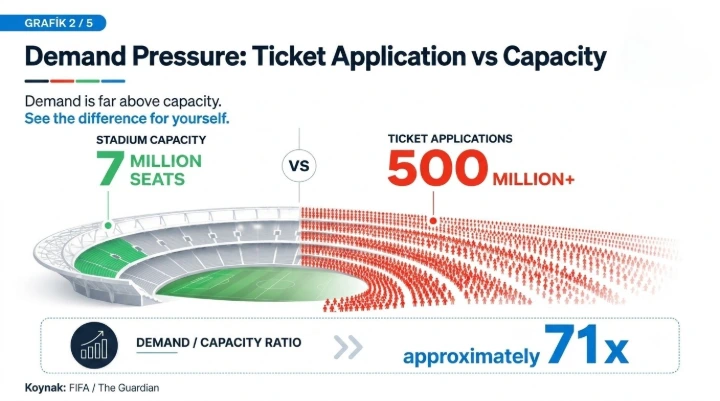
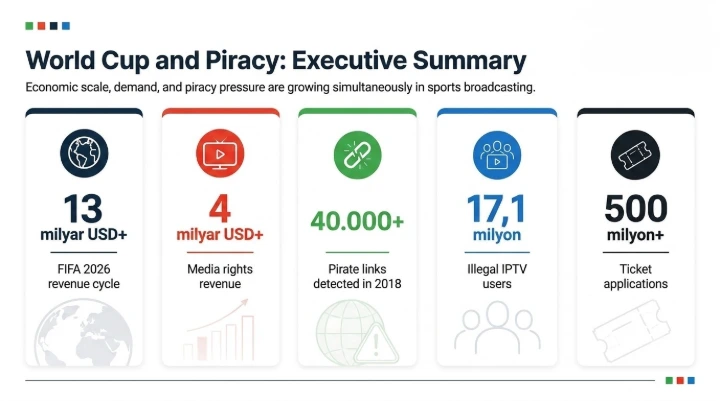
Previous tournaments illustrate the scale of the challenge. During the 2018 FIFA World Cup, Viaccess-Orca identified more than 40,000 infringing streaming links. Four years later, during the 2022 tournament, the U.S. Attorney's Office for the District of Maryland seized 55 domain names used to illegally stream FIFA World Cup matches. The case demonstrated how quickly piracy networks can organize and scale their operations around major sporting events.
The risks extend beyond rights holders.
Major tournaments also create opportunities for cybercriminals targeting fans. Fake streaming websites, phishing campaigns, and malicious redirects become significantly more common as demand for live coverage increases.
In May 2026, the FBI issued a public warning about fraudulent domains impersonating FIFA and phishing campaigns designed to exploit the excitement surrounding the tournament. Similar trends were documented by Zscaler ThreatLabz during the 2022 FIFA World Cup, where fake streaming websites, "free live match" offers, malicious redirects, and payment fraud campaigns were all observed targeting football fans.
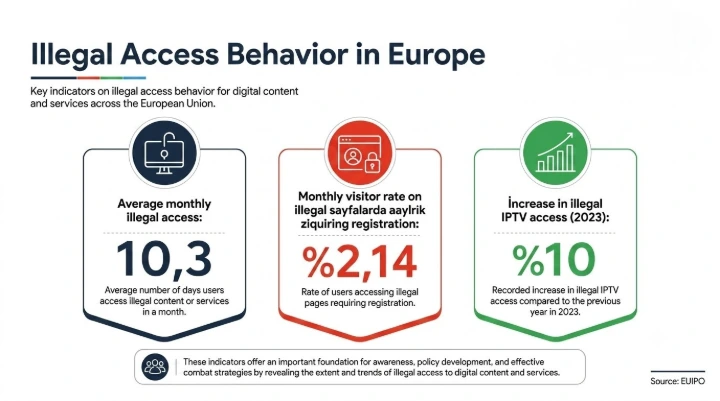
Today, piracy is no longer driven by isolated websites alone. The ecosystem has become far more organized, commercialized, and resilient. One of the clearest examples is the rise of illegal IPTV networks.
These operations often follow a subscription-based business model. They build reseller networks, sell access packages, and in many cases attempt to replicate the user experience of legitimate streaming platforms.
A report published by the Audiovisual Anti-Piracy Alliance (AAPA) and prepared by Bournemouth University illustrates the scale of the problem. According to the report, approximately 17.1 million people aged 16 to 74 across the European Union and the United Kingdom used illegal IPTV services in 2021. The same study estimates that illegal IPTV providers generated more than €1 billion in revenue, while legitimate pay-TV providers suffered substantial financial losses.
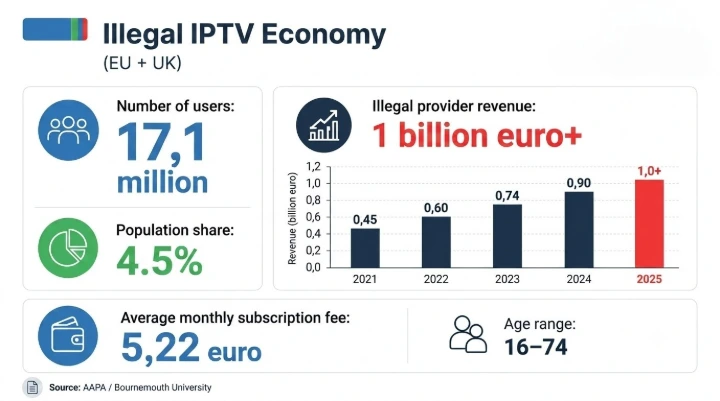
Much of this revenue flows through unregulated channels. In many cases, it is difficult to determine who ultimately profits, where the money goes, or how these networks continue to expand. For consumers, these services are often linked to additional risks, including fraud, phishing attempts, malicious redirects, and payment-related scams.
Reducing this issue to simply "watching football for free" would therefore miss the bigger picture.
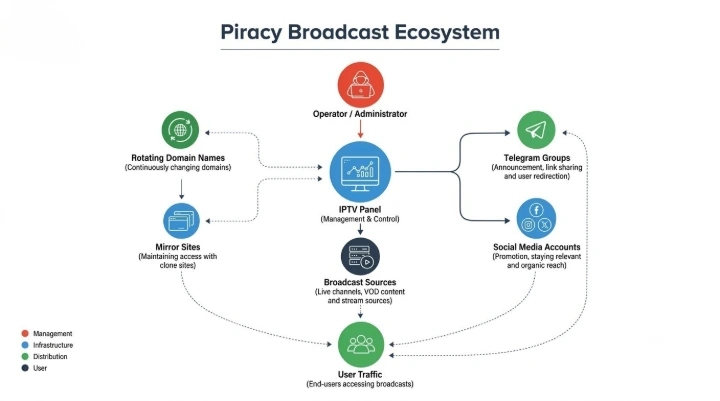
What exists today is an underground digital marketplace built on subscription models, reseller networks, advertising revenue, traffic acquisition, and payment infrastructures. From an operational perspective, we encounter this reality every day.
These networks rarely rely on a single website or domain. Instead, they operate through constantly rotating domain names, backup domains, Telegram channels, social media accounts, and multiple embedded video players that often belong to the same distribution ecosystem.
That is why every distribution channel must be assessed individually.
Which video player is being used? Where does the domain redirect? Is traffic coming from search engines, social media, or Telegram communities? Is the content distributed through a website, an IPTV panel, or a messaging platform?
The answers matter because the most effective enforcement approach, the expected outcome, and the required response time differ from one channel to another.
The strategy used for a social media post is not the same as the one applied to a streaming website hosted offshore. Reducing the visibility of infringing search results is a different process from disrupting the source of an unauthorized live stream.
We explored this distinction in greater detail in our previous article for readers interested in the operational differences between these enforcement approaches.
The IPTV environment introduces another layer of complexity. What appears to end users as a single service is often supported by multiple content sources, distributed across different servers and interconnected delivery chains.
This raises a more fundamental question:
How should operational success actually be measured? Is it simply the number of links removed?
At Govinet, our answer is clear: no.
The effectiveness of live sports enforcement cannot be measured by takedown numbers alone. Detection speed, verification time, selecting the appropriate enforcement channel, identifying recurring sources, and achieving results while the event is still live all need to be considered together.
During a single match, we may identify hundreds of infringing links. Some originate from the same underlying source. Others are little more than duplicate pages created solely to capture traffic. Only a portion actually provide active streams to viewers.
That is why prioritization is essential.
Not every link deserves the same level of attention.
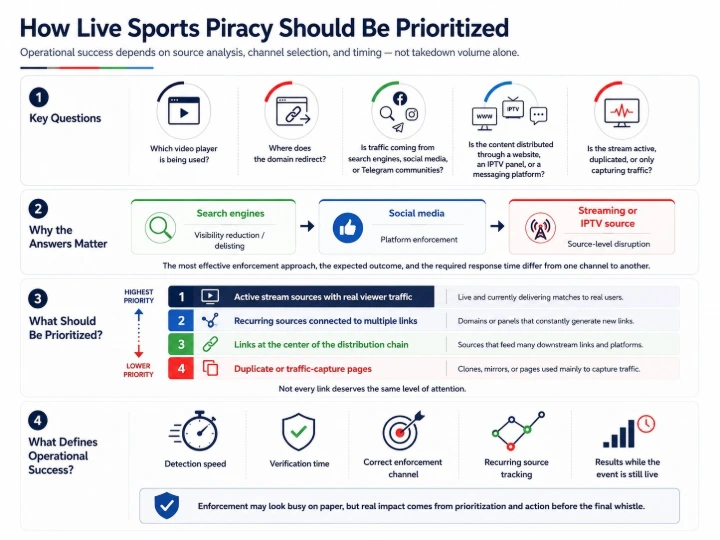
Active sources that attract significant viewer traffic and sit at the center of a distribution network deserve a different level of attention than pages that merely appear in search results without providing access to a live stream.
Without this distinction, enforcement operations may look impressive on paper while delivering only limited real-world impact.
The importance of prioritization becomes even greater during high-profile events such as the FIFA World Cup. Piracy networks typically operate around match schedules. Domains change rapidly. Social media accounts appear and disappear. Some links become active only minutes before kick-off, only to be abandoned or redirected once the match ends.
We see this regularly during live enforcement operations.
Just minutes before a major match, hundreds of new domains can become active almost simultaneously. By the time the final whistle blows, many of them have already disappeared. This is why responding during the match is only part of the equation. Effective enforcement begins long before the event goes live.
Before a tournament starts, monitoring lists should already be in place. Known high-risk domain families should be reviewed, previously active networks re-examined, and search trends, social media activity, and messaging platforms monitored well before kick-off.
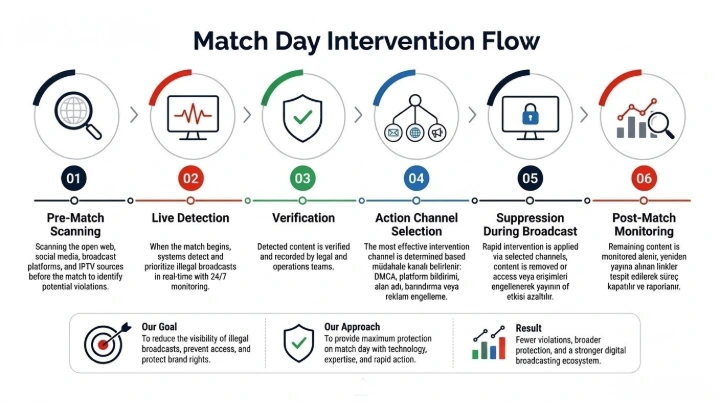
From the outside, this may appear to be little more than a process of removing infringing links.
In reality, live sports enforcement is a race against time.
Ultimately, the battle around live sports is not confined to the stadium. Rights holders, broadcasters, and streaming platforms invest heavily in content, broadcasting rights, and the infrastructure required to deliver live events to audiences worldwide. At the same time, piracy networks work just as hard to monetize that demand through unauthorized distribution.
At Govinet, our position is clear.
Success is not measured after the final whistle.
It is measured by the ability to achieve meaningful results while the match is still being played.
References
Audiovisual Anti-Piracy Alliance (AAPA) & Bournemouth University. Illicit IPTV in Europe: Economic Report. December 2022.
European Commission. Commission Recommendation of 4 May 2023 on Combating Online Piracy of Sports and Other Live Events (C(2023) 2853 final). 2023.
Federal Bureau of Investigation (FBI). Threat Actors Spoofing FIFA Websites in Advance of the 2026 World Cup. May 2026.
OECD. Piracy of Digital Content – Chapter 4: Case Study: The Sports Rights Owners Sector. OECD Publishing, 2009.
U.S. Attorney's Office, District of Maryland. Seizure of 55 Domain Names That Violated Copyrights by Illegally Live Streaming the FIFA World Cup. December 12, 2022.
Viaccess-Orca. Anti-Piracy Summary Report 2018: Fighting Illegal Streaming During the World Football Tournament 2018. 2018.
World Intellectual Property Organization (WIPO). Sport and Broadcasting Rights: Adding Value.
World Intellectual Property Organization (WIPO). Broadcasting and Media Rights in Sport.
Zscaler ThreatLabz. Surge of Fake FIFA World Cup Streaming Sites Targets Virtual Fans. November 2022.