
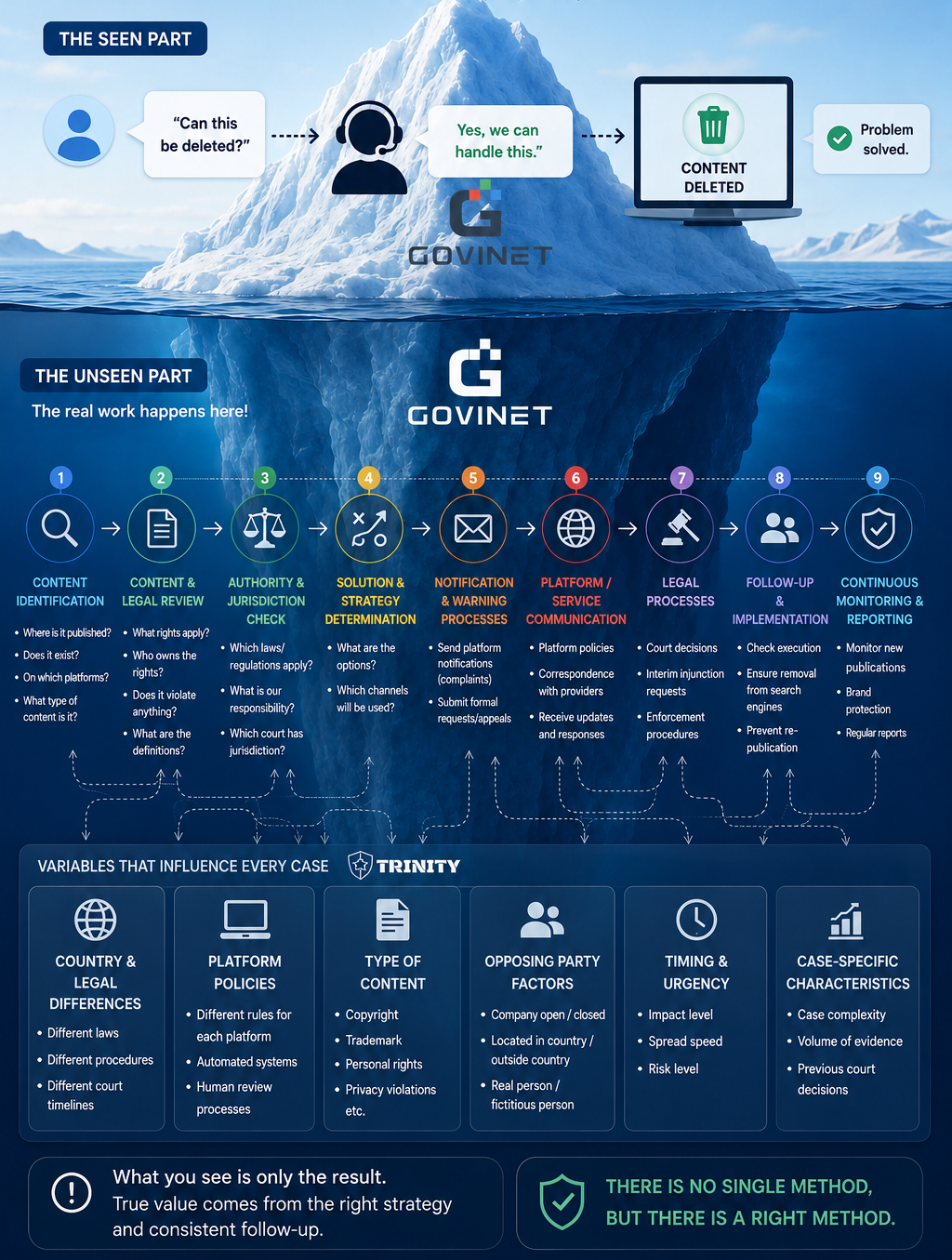
Digitalisation is increasing. This is leading to more unauthorised use of content. As artificial intelligence technologies become more widespread, we expect this issue to grow further in the future. For this reason, our clients usually ask us the same question first: ‘Can we remove this?’ Our answer is short and clear: 'Yes, we can resolve this issue.
However, this simple answer is actually just the tip of a complex, interlinked process. In this blog post, we'll be discussing the dark waters beneath the tip of the iceberg, which is a topic that we will be exploring in more detail.
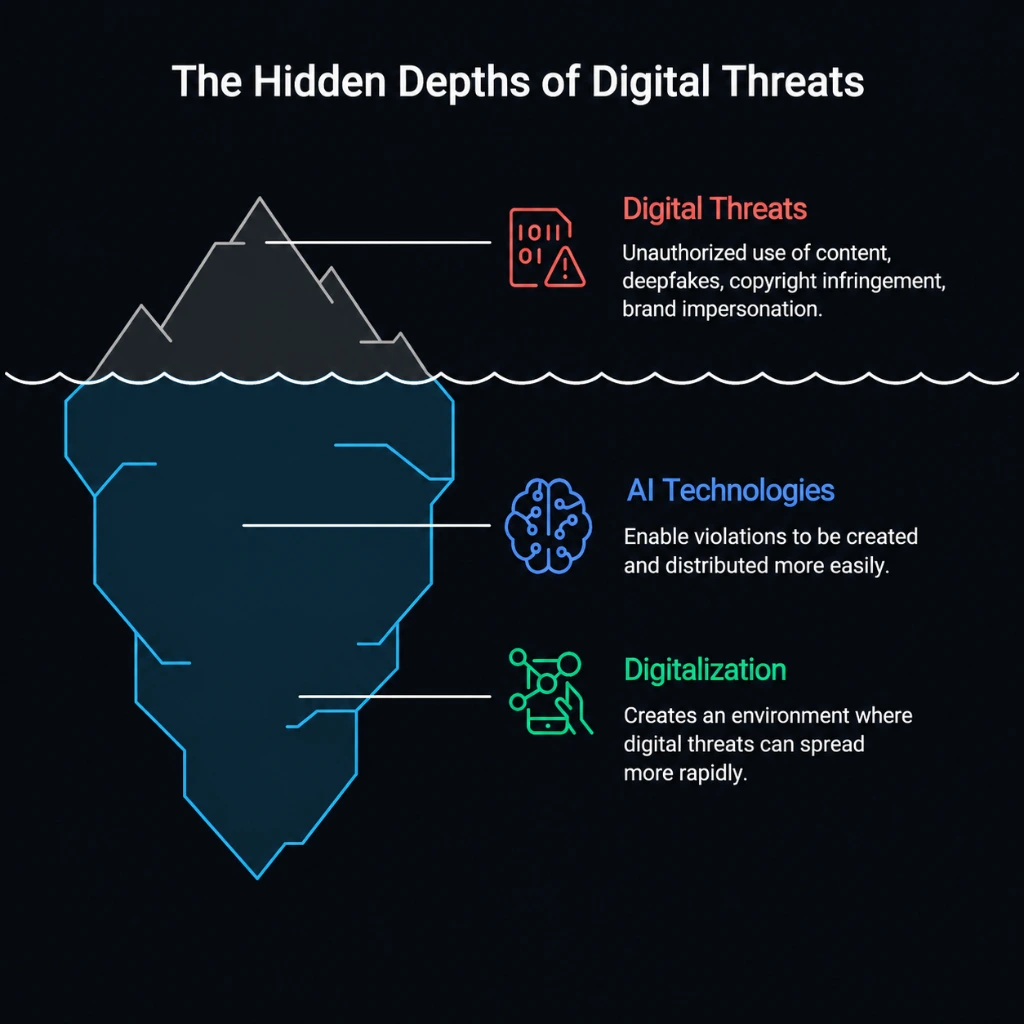
As digital technology becomes more widespread, there is an increase in unauthorised content use, deep fake content, copyright violations and brand theft, which are all examples of digital threats. The development of artificial intelligence technologies makes it easier to produce and distribute these violations. Therefore, it is not difficult to predict that these problems will increase in the coming period.
You may have come across unwanted content online. This could be related to your brand. It could be related to the content you produce.
Our response to customers seeking support—"Yes, we can sort this out"—seems straightforward, but behind the scenes, things are not nearly that simple. Many people assume that all problems can be resolved using a single method. However, in this type of content, the solution to each case is unique. The type of content, the platform on which it is published, the legal situation, and the technical conditions all directly impact the solution method and workflows.
Let’s take a quick look at the background;
Govinet's primary focus is on accurately identifying problems rather than employing a one-size-fits-all solution in every case
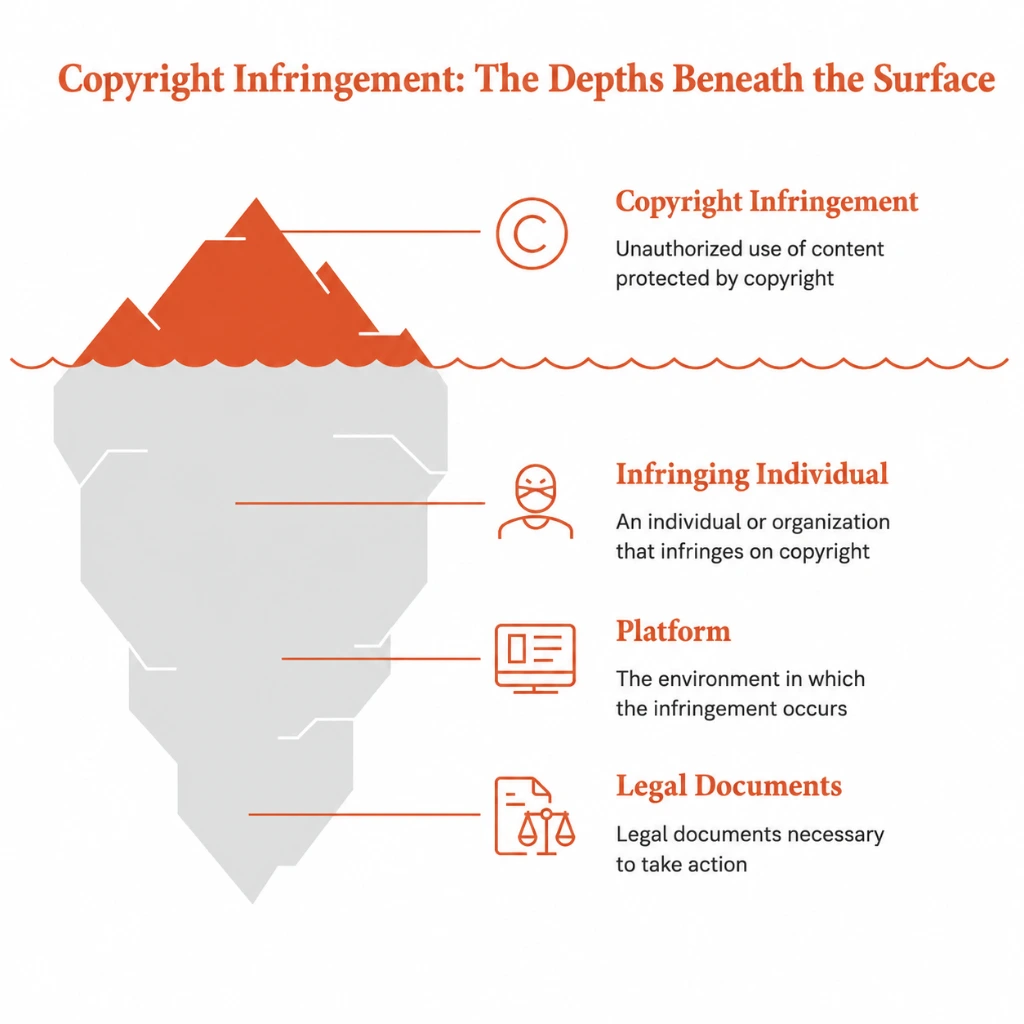
What exactly is the problem?
Answer: Copyright infringement.
What information and evidence is available to help us reach a solution?
Answer: The person responsible for the infringement, the platform, and legal documents enabling us to take action.
What is the most appropriate course of action for this case?
Answer: Delisting and takedown.
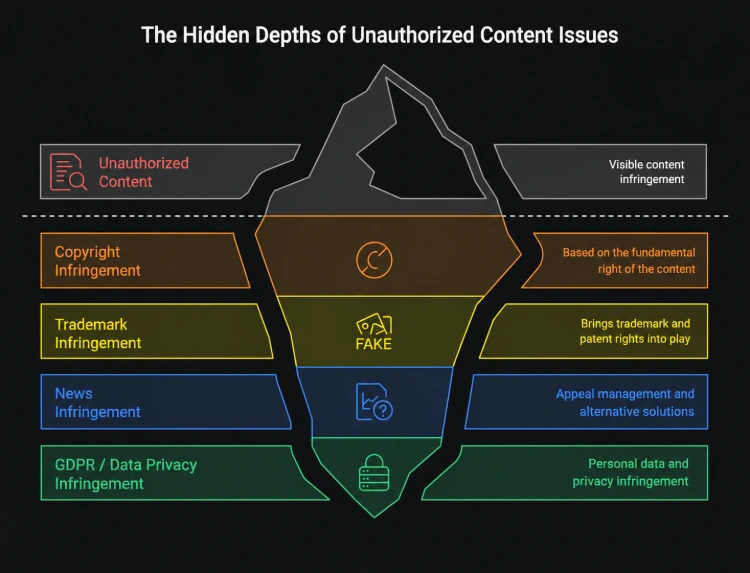
In matters of unauthorized use of content, the preliminary evaluation is conducted from a copyright standpoint. The key factor in this process is content ownership. Copyright infringement is a distinct area of assessment that differs from other forms of content infringement in terms of its legal basis, methods of proof, and resolution mechanisms.
Trademark
If the issue concerns a counterfeit product imitating your trademark, it is a far more complex matter; in such cases, trademark and patent rights, misleading consumers, platform policies and elements of fraud may all come into play.
News content
often falls within the scope of reputation management if the subject matter is news-related. In such cases, complete removal of the publication may not always be the solution, and alternative options are always on the table. Depending on the nature of the content and its legal basis, options such as the right of reply or correction, updating the news item, or reducing its visibility on search engines may be implemented.
KVKK / GDPR
The sharing of personal information on a forum or social media platform is treated as a breach of personal data and privacy.For all these reasons, when we begin to resolve the issue, we strive to make the correct diagnosis by asking the right questions. Where an accurate diagnosis is not made, the process may be prolonged and may even prove fruitless.
One of the most common issues we face during our operations is when clients expect a resolution based on only a single screenshot or a single URL. However, one of the most important elements of our resolution process is the evidence that leads us to a solution. Crucial steps in such processes include recording URLs, taking screenshots, verifying the date of the infringement, creating archive records, preparing documents demonstrating ownership and if necessary, recording WHOIS and hosting details.
Now let’s imagine a single piece of content going viral. We know that bad news always has a high potential to spread rapidly and create a viral effect. In such a situation, let’s consider that it is no longer just a single link, but thousands and sometimes even hundreds of thousands of copies of the same content appearing across different platforms, forums, social media accounts and websites. At this point, the process ceases to be merely a matter of content removal requests and becomes a large-scale incident management operation. Each link must be identified individually, categorised, the appropriate intervention methods determined, and processed separately. Moreover, every link that remains online can pave the way for the content to be disseminated again and go viral once more. For this reason, it is of critical importance that every URL is recorded with a unique case or file number, that its processing history is tracked, its status is kept up to date, and that it is reported on a regular basis.
As the number of links increases, the process does not become more complex in a linear fashion, but rather transforms into an exponentially more complex organism. This organism becomes a mass with its own internal dynamics that is constantly changing form. The fact that content is disseminated across different platforms, is subject to different legal mechanisms, and requires separate processing for each one makes coordination, monitoring and quality control significantly more difficult. A successful outcome is only possible through systematic case management, robust automation and continuous monitoring.
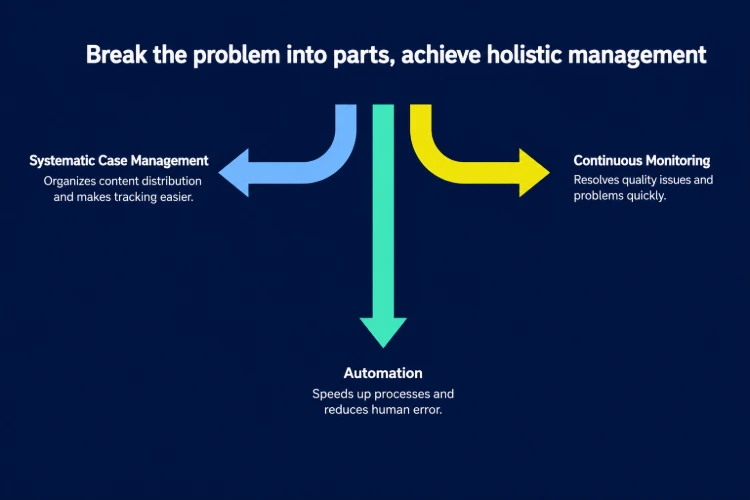
The internet is an ever-changing organism. Whilst our operations team is preparing deletion procedures, a page may be updated, moved to a different domain, or removed entirely. Actions taken on the basis of incomplete information may result in a request for further details, or the matter may not be processed at all. Particular attention must be paid to this stage in order to expedite the process. Evidence must be gathered with care, and the files to be submitted to the courts, along with the associated data sets, must be meticulously compiled and linked to the relevant case.
One of the most common requests we receive is: ‘Let’s remove this content from Google; that will take it down.’ Unfortunately, this does not solve the problem. Google does not host publications or content itself, it simply indexes web pages found on the internet and displays them to users. For this reason, removing content from Google is not always the definitive solution. Firstly, an analysis must be carried out to determine where the content is hosted and through which channels it can be accessed. In most cases, Google is not the owner or publisher of the content. Google is merely a search service that directs users to the relevant page. The real point of intervention is the source where the content is located.
Another misconception we encounter relates to websites. A website appears to be a single entity from the outside. However, behind the scenes, it works in conjunction with various service providers. These may include the platforms hosting the content, the hosting provider storing the files, the organisation where the domain name is registered, and the site may also be using a CDN or reverse proxy service. All these elements, and many others like them, are different parts of a whole.
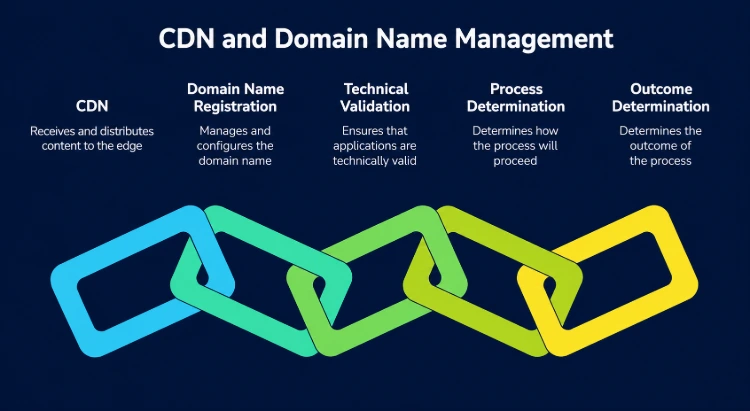
For example, a CDN is not the original source of the content. Its function is to distribute and route cached copies. The organization that registers the domain name does not manage the page content, either. That is not its role or function. Therefore, correctly determining where, to whom, and how to make an inquiry affects how the process will proceed and what the outcome will be.
The most common misunderstanding we encounter in the industry and in the inquiries we receive relates to the DMCA. When it comes to removing content from the internet, the DMCA is one of the best-known concepts. However, one of the most common misconceptions we encounter in practice is the belief that every issue can be resolved through the DMCA. Put simply, the DMCA is a standard established under copyright law, and many international platforms apply this standard in cases of copyright infringement.
"Can you really remove all content?"
We always respond to this question with transparency.
"Not all content can be removed."
Some content is removed in accordance with the platform’s rules. Some content may only be removed from search results. For some, a court order may be required. Furthermore, in some cases, removal may not be possible for legal or technical reasons. News websites may not be able to remove content where publications are in the public interest.
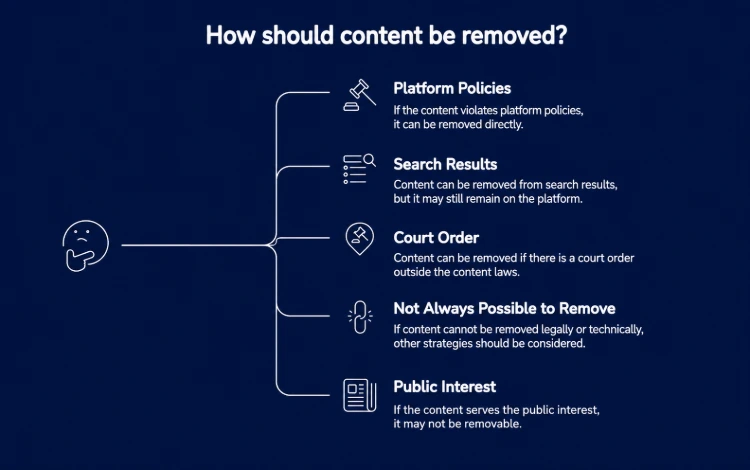
The fundamental approach to content removal processes is to assess each case on its own merits. The aim is not to apply the same standard to every issue, but to determine the most effective strategy by accurately analysing the root cause of the problem. Our experience spanning over 10 years, along with records of the millions of transactions we have processed, is securely stored in our ‘Trinity’ Dashboard. Thanks to Trinity, we manage our processes in a sustainable, transparent and scalable manner, ensuring that every transaction is fully traceable and reportable from start to finish.
Govinet.