
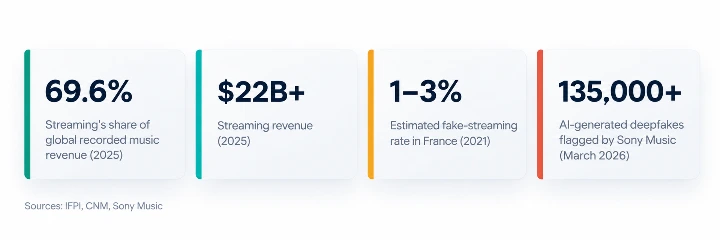
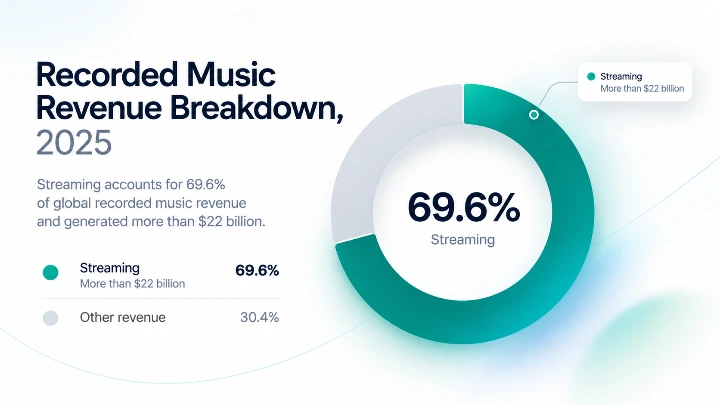
Most music is now listened to through streaming platforms, and most of the revenue comes from the same place. According to IFPI, streaming made up 69.6% of global recorded music revenue in 2025 and passed $22 billion.
If part of that money is flowing to the wrong accounts because of streams with no real listener behind them, the loss usually goes unnoticed. That is why artificial streaming is one of the most frustrating problems in the industry: it distorts royalty shares and charts, and it is hard to trace.
What is artificial streaming?
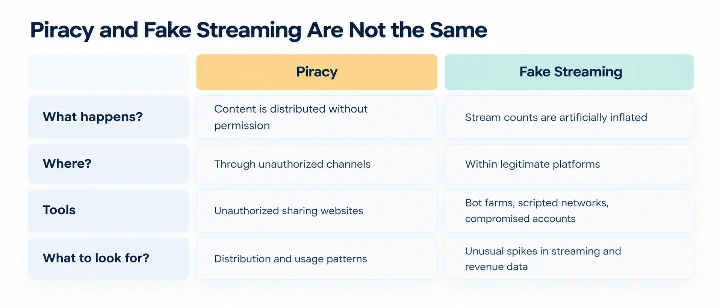
Artificial streaming means inflating a track's play count by artificial means. Typical tools are bot farms, automated scripts, hijacked user accounts, or services that sell plays for money. The goal is usually one of two things: to take a share of royalties that isn't earned, or to make a track look more popular than it is.
It should not be confused with piracy. With piracy, content is distributed without permission. With artificial streaming, the content sits on a legitimate platform and what gets manipulated is the measurement. Both hurt a rights holder's income and visibility, but you check for them in different places.
The global picture: what do the numbers say?
One of the most concrete references is the study published by France's Centre national de la musique (CNM) in January 2023. Based on 2021 data, roughly 1 to 3% of streams in France were fake. By platform, the share of fake streams detected was 2.6% at Deezer, 1.6% at Qobuz and 1.14% at Spotify.
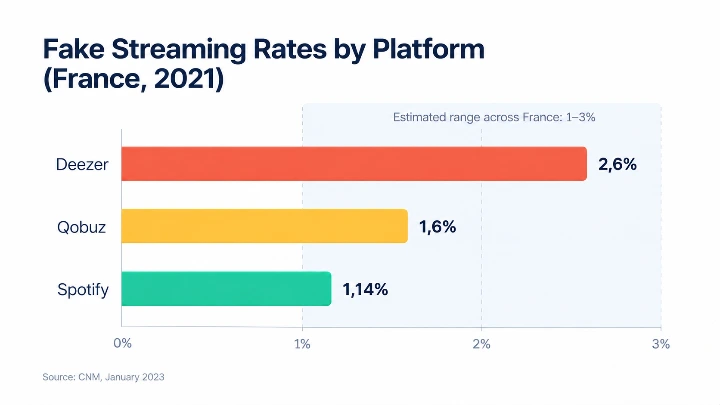
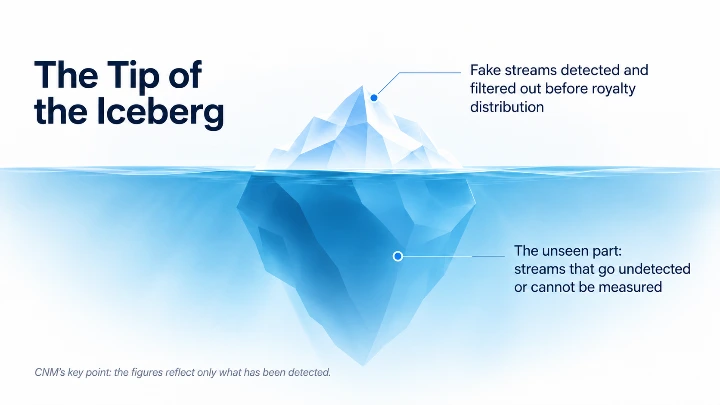
CNM stressed that these figures show only the visible tip of the iceberg. In other words, they count the streams that were caught and removed before royalties were distributed.
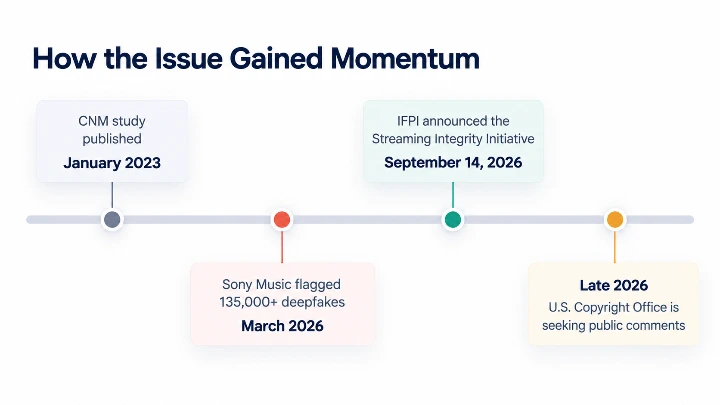
The problem is not limited to France. On 14 September 2026, IFPI announced the Streaming Integrity Initiative, joined by major labels and distributors. It includes commitments on know-your-customer (KYC) checks, rights verification and sharing fraud detections. Toward the end of 2026, the US Copyright Office also began collecting public input to understand how widespread the problem is and what it costs the economy. In short, the issue now sits near the top of the industry's agenda.
When AI enters the picture
Generative AI has made this easier and added a new dimension. Observers in the industry report that a significant share of streams on some AI-generated tracks appear to be artificial. There are also deepfakes that imitate artists' voices and identities: as of March 2026, Sony Music said it had flagged more than 135,000 AI deepfakes of its artists for removal.
It helps to keep one distinction clear. AI-generated content is not fraud by itself. The problem starts when that content is combined with unauthorized impersonation or artificial stream manipulation. What a rights holder really needs is a clear view of two things: who owns what, and where and how it is being used.
What we know and don't know about Türkiye
The figures above come from France and from global platform data. There is no publicly available, verified measurement of artificial streaming for Türkiye. So it would be wrong to say "1–3% applies in Türkiye too." Those percentages give a framework for understanding the method and how the market works, not a local loss estimate.
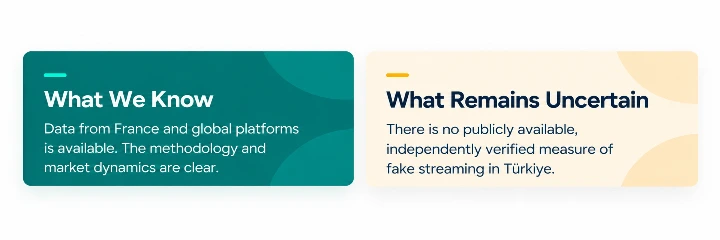
A reasonable approach is this: since artificial streaming is a global method, rights holders in Türkiye should ask the same questions. Instead of presenting guesses as realized losses, it is far sounder to start by making the stream, rights and distribution data in your own catalog traceable.
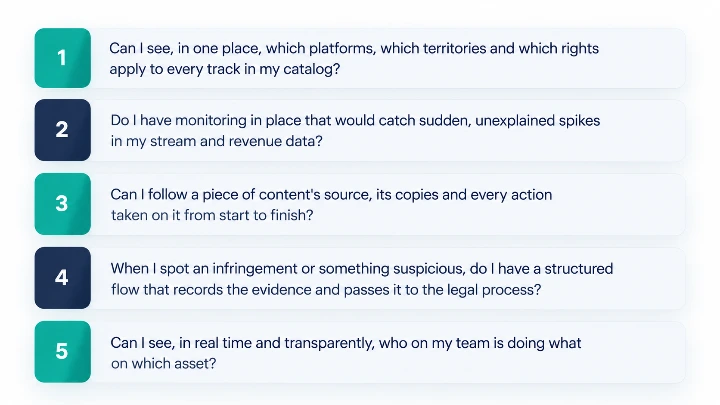
Five questions every rights holder should ask
Why traceable operations make a difference
Visibility is the foundation of the fight against artificial streaming. If you can't see what belongs to you, where it is published and how your data moves, you can't spot a problem, and you certainly can't prove one. Scattered spreadsheets and disconnected processes are where manipulation is most comfortable.
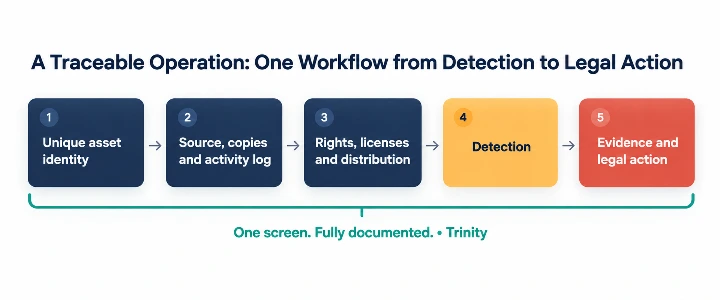
This is where Govinet's Trinity comes in. It brings content protection, rights management and performance data together in a single operating system. Each asset gets a unique ID, so its source, copies and the actions taken on them can be traced. Rights, licences and distribution appear on one screen across territories and time zones. Every step from detection to legal process is structured and recorded. That way operations run in the open and can be audited, instead of running blind.
Artificial streaming works unnoticed; visibility is what brings it into the open. When your content, rights and operations are traceable, it becomes easier to manage both today's risks and tomorrow's uncertainties.
Talk to Govinet about your content and rights management needs
https://www.govinet.com/contact